.svg)


Written by Timan, Interim Hyperscale Lead.
We did it! During today’s public Hyperscale test, we sustained 500,000 transactions per second, and saw peaks of over 700k TPS.
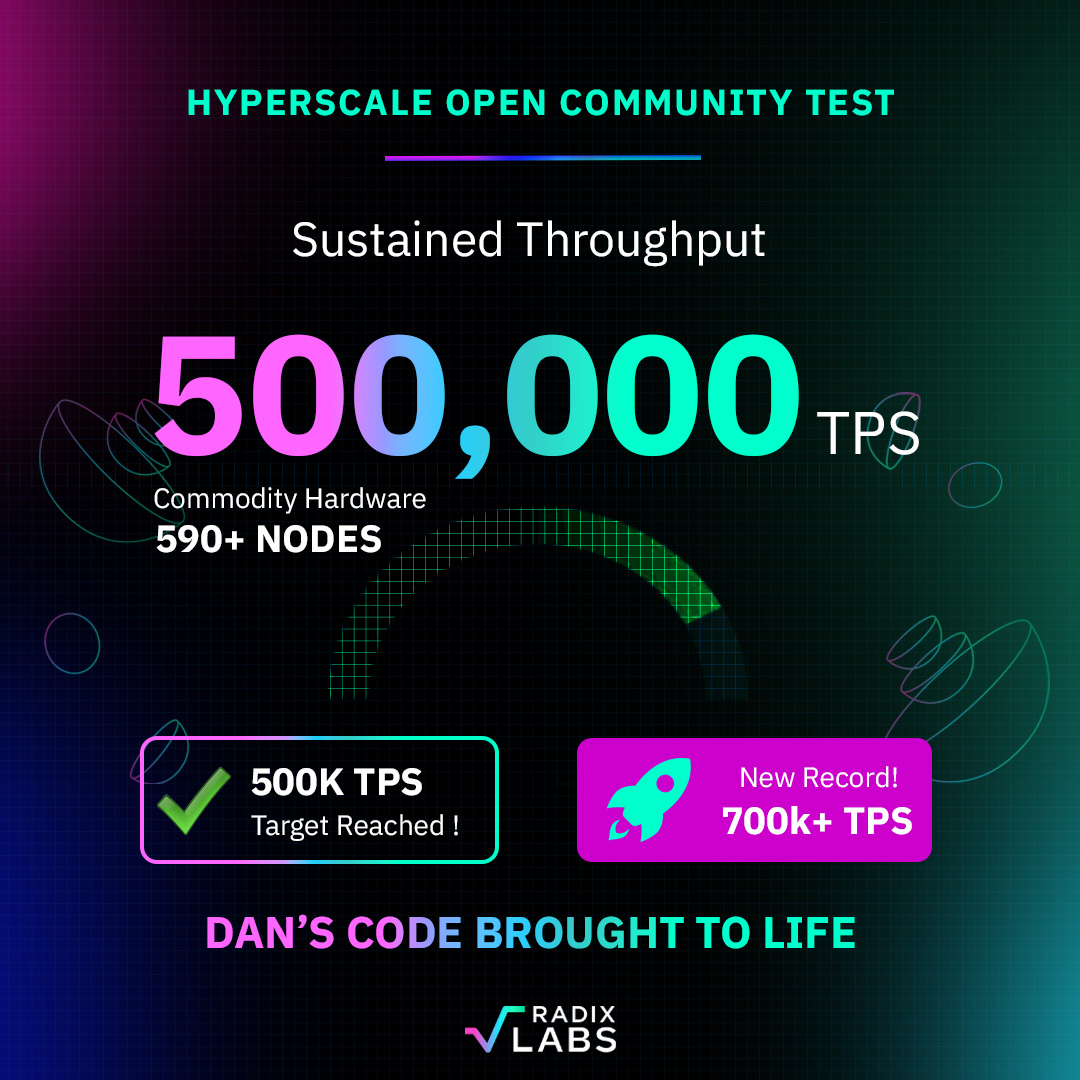
More than 590 nodes joined the test network, ranging from datacenter-grade nodes to desktops and even laptops. Hyperscale runs on commodity hardware, which made it possible to run a truly open participation test where anyone could join.
That openness matters, but the milestone itself is only part of the story.
Earlier this week, during a private test, we also demonstrated that Hyperscale scales linearly. We ran at roughly 250k TPS on 64 shards and reached the same per-shard throughput again at 500k TPS on 128 shards. That result matters more than the absolute number, because it confirms the underlying linear scaling assumptions of the architecture.
The workload itself is also worth calling out. These were not simple token transfers. They were swaps. That means real complex DeFi-style transactions, executed across more than a hundred shards, at extreme scale. What makes this result particularly meaningful is that it included cross-shard atomic transactions. This is a core property of Radix Hyperscale and a hard requirement for real linear scalability. It shows that the system can scale out across shards without fragmenting state or giving up the guarantees of a single, unified ledger. This is exactly what is needed for blockchains to scale to a global level, and is the scenario Hyperscale was designed for.
This was a public, non-validated performance test. The goal was to show what Hyperscale can do today under real-world conditions, not to produce a final, third-party-certified benchmark. We focused on reproducibility and community participation rather than controlled lab conditions. The configuration, tooling, log files, and dashboards will all be made available soon so others can study, reproduce, and build on these results.
A community effort
I want to thank everyone who participated. The node runners who joined the test, the people following along via public dashboards, and the many community members who helped others with onboarding, debugging installs, and configuring port forwarding. This was very much a community effort, and it showed.
Looking back, and forward
For me personally this marks a meaningful point in the interim Hyperscale phase. This was never about chasing a big number on a screen. It was about picking up where Dan left Hyperscale and showing that it works. The architecture is solid. And that it does not depend on a single person anymore. I am proud of what we achieved together.
With the Foundation handing the reins over to the community, the future of Hyperscale now sits with you. Some community members have already started working on a Rust implementation of Hyperscale, and more initiatives are taking shape. What comes next will be community-driven, and that is exactly how this system was meant to evolve.